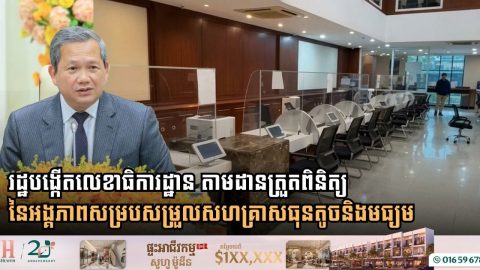
Immovable property and tax registration procedure in Cambodia

Immovable property registration is very important in managing, trading, and transferring property. It also confirms the legitimacy of those immovable properties. Immovable property registration is subject to any land and buildings that are taxable. Generally, all property owners with immovable properties worth more than 100,000,000 riel are taxable. (Read more)

According to the Law on Immovable Property Tax 2009, all property taxpayers are obliged to register their immovable properties at any fiscal administration where their properties are located. This registration is to be made by the end of September of each tax year and the property which has already been registered is not re-registered in the following year.

An immovable property registration is done only once but the tax payment on immovable properties throughout Cambodia take place annually with a rate of 0.1%. The tax payment is dependent on the type of property and where it is located.

When the registered property is transferred through acquisition or change of ownership, change in size, distribution or dissolution, the immovable property owner must pay a 4% rate of registration tax.

e.g. Mr. A has 3 hectares of land in Siem Reap city. He has to register his property and pay the tax at 0.1% rate. Later on, he divides the lands into 3 lots for his three children. So, the transfer of ownership of 3 lots must be paid the registration tax at 4% rate. In this case, in the year the lands are distributed to his children he did not pay the annual tax; however, his children have to pay 0.1% tax and 4% tax in the same year.

In principle, immovable property owners must measure and calculate their property taxes on their own.

How to measure immovable property?

The owner of the property must measure the area of ​​land, houses, and other constructions. For land, the owner has to measure it taking the centre of the fence or the boundary as a basis. The houses, buildings, and other constructions are measured from the centre of the wall and the roof for gas stations, restaurants, shops or car washes.

The calculation of immovable property tax

To know how much to pay, firstly the tax basis has to be calculated by multiplying the value of immovable property by 80% and subtracting 100 million riel. Then, multiply the number of tax basis by 0.1% (annual tax rate for immoveable property).

Prakas No. 343 SHV. PRK dated 22 March 2019 on the determination of the registration tax basis for the transfer of ownership or possession of immovable property determines clearly the registration tax basis applicable to the transfer of ownership or possession of immovable property.

Moreover, the owner should remember that the value of an immovable property shall be determined by the Immovable Property Assessment Commission depending on market value​ or depending on the age of the construction and the type of construction (concrete and non-concrete bricks).

What documents are required when registering?

After measuring and calculating, the owner has to register its immovable property tax. When applying, the owner should bring important documents such as:

– Letter of Birth or Identity Card or Passport for foreigner

– Family Book or Residence Book or Residence Certification

– A title of possessory right over immovable property or a certificate of ownership over immovable property issued by the cadastral administration or any documents relating to the occupation of the property as specified by the Commune / Sangkat Authority. In the event of a down payment, the property owner must also bring the buyer and seller documents.

In addition, the property owner must make clear to the fiscal administration about the taxable property in the case of:

  • The immovable property is divided to sell, transfer or grant and when the divided property should be registered under new ownership
  • Land used for houses, buildings and other constructions
  • Houses and buildings and structures have been added or reduced or demolished
  • A change in owner, occupant or final beneficiary

The taxpayer cannot falsify immovable property tax registration documents. If the tax official discovers that a taxpayer is falsifying the documents, the person is liable under the law on taxation to have an additional tax penalty imposed on the tax of immovable property tax.

For ease of time and expense, taxpayers can download this application form free of charge on the Department of Taxation’s website (www.tax.gov.kh).


- Video Advertisement -

Related Post

Cambodian Dimension Stone Sector Generates Nearly $40 Million for National Economy

The Cambodian dimension stone and processed marble industry has emerged as a key pillar supporting the national economy, contributing nearly $40 million in royalty revenues between 2022 and early 2026. This significant financial milestone, which excludes additional internal taxes, duties, and levies, underscores the growing economic importance of the country’s domestic mineral and stone assets. […]

Chinese Research Institute and Major Corporations Explore Strategic Green Investment Opportunities in Cambodia

In a significant move toward fostering sustainable economic ties, a high-level Chinese delegation comprising leaders from a prominent research institute and several major corporations has initiated talks to explore green investment opportunities within Cambodia. The collaborative effort took center stage during an official meeting held on the afternoon of June 23, 2026, at the Ministry […]

New York City Fortifies Coastline Against Future Superstorms

In the years following the devastating flooding caused by Hurricane Sandy in 2012, New York City has undertaken a massive engineering effort to transform its vulnerable coastline into a resilient fortress. Central to this transformation is the East Side Coastal Resiliency project, which utilizes advanced infrastructure to protect critical utilities like Con Edison’s East River […]

ADB Approves $63.44 Million for 250MW/500MWh Battery Energy Storage System in Cambodia

The Asian Development Bank has officially approved a $63.44 million financial support package for the Royal Government of Cambodia to construct a 250MW/500MWh Battery Energy Storage System at the Takeo substation in southern Cambodia. According to the announcement of the Asian Development Bank (ADB) on June 24, 2026, the comprehensive financing package consists of a […]

Rooting for the Future as Kampot Greens Its Iconic Landscape with Thousand Tree Initiative

Peng Huoth Group joins forces with environmental authorities and IUCN to plant trees at Phnom Kampong Trach, supporting Cambodia’s 2050 carbon neutrality goal In a collaborative effort to expand Cambodia’s forest canopy and nurture a deep-seated culture of environmental stewardship, a major reforestation event successfully took place in the scenic landscapes of Kampot province. Organized […]

Cambodia Extends Tax Incentives for Domestic Cement Industry to Bolster Growth and Competitiveness

Prime Minister Hun Manet announces a two-year extension until the end of 2028 emphasizing that local business success acts as the ultimate advertisement for foreign investment In a decisive move to strengthen national infrastructure and support industrial self-reliance, the Cambodian government has officially extended its tax incentive package for domestic cement manufacturers for an additional […]